
Your cart is empty.
Browse Peptides
June 18, 2026
Selecting Peptide Sequences for Target Study: 2026 Guide
Peptide sequence selection is defined as the process of identifying and refining amino acid sequences that bind a specific molecular target with measurable affinity, stability, and functional activity. For researchers designing target-specific peptides in 2026, this process now integrates machine learning frameworks like GFlowNet and CreoPep alongside classical structure-activity relationship analysis. Getting it right at the sequence level determines whether a candidate survives synthesis, assay validation, and downstream in vitro evaluation. Selecting the right peptide sequence for a target study requires balancing binding affinity, solubility, protease stability, and membrane permeability from the very first design cycle.
What are the primary considerations for selecting peptide sequences for target studies?
The first decision in choosing peptide sequences is defining exactly what you are optimizing for. Affinity alone is not sufficient. A peptide with subnanomolar binding that degrades in serum within minutes or precipitates at assay concentrations delivers no usable data. Researchers must define whether the goal is single-target affinity, multi-target selectivity, or a combination of functional endpoints before any sequence modeling begins.
Four physicochemical properties govern experimental success in most target studies:
- Binding affinity: The KD value must fall within a range relevant to your assay format. Rational substitutions in cyclic peptides have pushed KD values to as low as 12.3 NM, demonstrating how targeted residue changes produce measurable gains.
- Solubility: Peptides with high hydrophobic content aggregate at physiological pH. Solubility must be modeled before synthesis, not discovered after.
- Protease stability: Linear peptides are vulnerable to serine and cysteine proteases. Cyclization, N-methylation, or incorporation of D-amino acids extend half-life in cell-based assays.
- Membrane permeability: For intracellular targets, permeability is a hard constraint. The CycDiff-DPO framework co-optimizes permeability alongside binding affinity across 56 protein targets, showing that permeability can be engineered rather than left to chance.
The experimental context shapes every decision. In vitro binding assays tolerate lower solubility thresholds than cell-based functional assays. Researchers working with membrane-bound receptors face different permeability demands than those targeting soluble enzymes.
Pro Tip: Define your optimization targets as a ranked list before generating any candidates. Knowing that permeability outranks raw affinity for your target class will save you from synthesizing the wrong compounds.

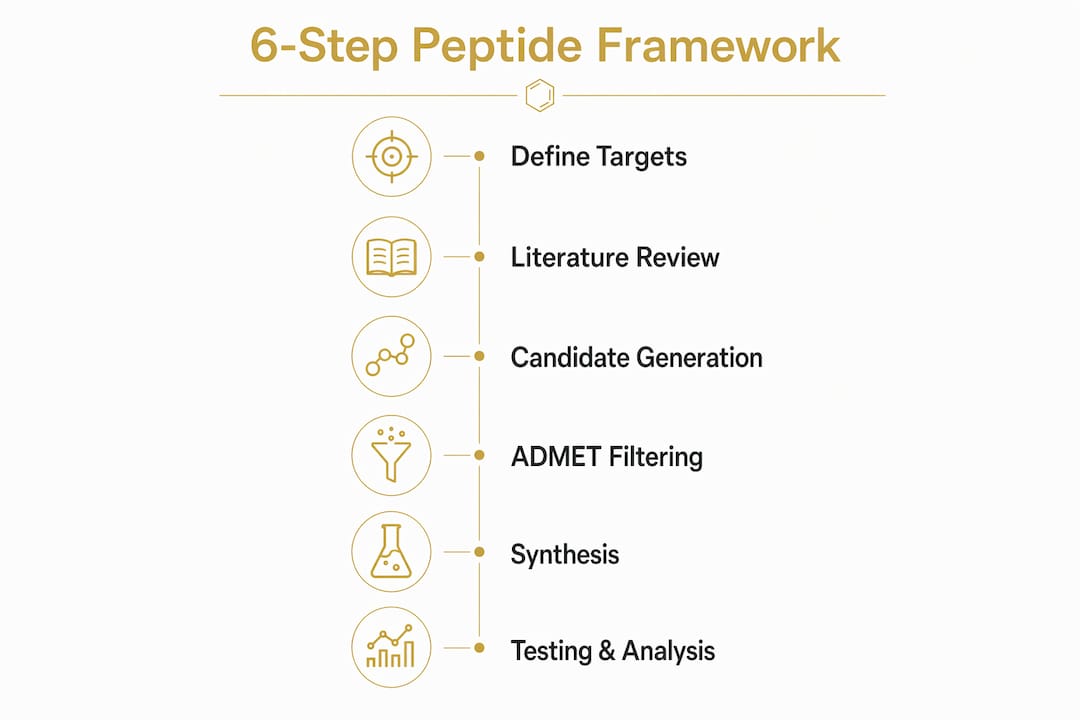
How to apply a structured 6-step framework to peptide sequence selection
A 6-step iterative framework structures the entire peptide design process from initial target definition through experimental feedback. Each step feeds the next, and experimental results from step five directly improve the models used in step two.
- Define specific optimization properties. State the target, the binding site, and the ranked property objectives. Ambiguity here propagates through every downstream step.
- Model and explore sequence space computationally. Use latent space projections to map the sequence landscape. Low-dimensional latent space optimization improves both computational efficiency and interpretability, making it easier to understand which sequence features drive predicted fitness.
- Generate and score candidates via machine learning or rational design. CreoPep uses progressive masking and temperature-controlled multinomial sampling to generate diverse peptides guided by target labels. This produces candidates with enhanced receptor specificity rather than generic high-affinity binders.
- Filter based on synthetic accessibility, toxicity, and intellectual property. Candidates that cannot be synthesized at reasonable cost, that show predicted cytotoxicity, or that fall within existing patent claims must be removed before any lab work begins.
- Synthesize and evaluate experimentally. Run binding assays, stability tests, and permeability measurements on the filtered set. Collect quantitative data for every candidate.
- Incorporate experimental results to refine the next round. Feed assay data back into the model to update fitness predictions. This closes the loop and improves hit rates in subsequent cycles.
The table below maps each step to its primary tool category and output:
| Step | Primary method | Output |
|---|---|---|
| 1. Define targets | SAR analysis, literature review | Ranked property objectives |
| 2. Model sequence space | Latent Bayesian optimization | Sequence landscape map |
| 3. Generate candidates | GFlowNet, CreoPep | Scored candidate library |
| 4. Filter candidates | ADMET prediction tools | Synthesizable, safe shortlist |
| 5. Experimental evaluation | HPLC, binding assays | Quantitative affinity and stability data |
| 6. Feedback and refinement | Model retraining | Improved next-round predictions |
Pro Tip: Run ADMET filtering in step four before committing to synthesis. Removing toxic or insoluble candidates at the computational stage costs nothing. Removing them after synthesis costs both time and budget.
What are advanced strategies for rational sequence optimization and residue modification?
Rational sequence optimization starts with identifying which residues actually drive binding. Molecular docking and molecular dynamics simulations reveal the contact map between peptide and target, showing which side chains form hydrogen bonds, salt bridges, or hydrophobic contacts. Residues outside the binding interface are candidates for modification without affinity loss.
Several modification strategies consistently improve peptide performance:
- Pi-stacking substitutions: Replacing aliphatic residues at aromatic contact points with phenylalanine, tryptophan, or tyrosine strengthens binding through pi-pi stacking interactions. Structure-based design of cyclic peptides targeting delta-like ligand 3 demonstrated that site-specific substitutions substantially improved binding affinity through exactly this mechanism.
- Non-natural amino acid incorporation: Beta-amino acids, N-methyl amino acids, and D-amino acids resist protease cleavage and can lock the peptide into a bioactive conformation. This is particularly valuable for cyclic scaffolds where conformational rigidity correlates with potency.
- Constrained mutation strategies: Fixing critical binding residues identified through SAR while randomizing peripheral positions balances hit rate with conformational diversity. This approach avoids the trap of over-constraining the sequence, which limits the discovery of novel potent motifs.
“Maintaining a balance between structural constraints and sequence flexibility is key to discovering novel potent chemical motifs in peptide design.” — CreoPep framework analysis, Nature Communications Chemistry, 2025
Managing the trade-off between rigidity and diversity is the central challenge in rational design. Fully constrained sequences produce predictable but narrow chemical space. Fully flexible sequences generate diversity but dilute hit rates. The constrained mutation approach sits at the productive midpoint.
How to balance multi-objective optimization for peptide candidates
Binding affinity is one variable in a multi-dimensional problem. Pareto frontier analysis visualizes trade-offs between competing properties, showing researchers which candidates represent the best achievable balance rather than the theoretical maximum of any single metric. A peptide at the Pareto frontier cannot improve in affinity without worsening solubility, or vice versa.
The following comparison shows how single-objective and multi-objective approaches differ in practice:
| Criterion | Single-objective approach | Multi-objective approach |
|---|---|---|
| Optimization target | Binding affinity only | Affinity, solubility, permeability, stability |
| Failure mode | Late-stage attrition from poor ADMET | Balanced candidates with fewer surprises |
| Computational tool | Standard docking scores | Pareto frontier, CycDiff-DPO |
| Sequence diversity | Often low (mode collapse risk) | Higher with GFlowNet sampling |
| Experimental success rate | Lower | Higher across validation stages |
GFlowNet addresses a specific failure mode called mode collapse, where generative models converge on a narrow cluster of high-scoring sequences. GFlowNet samples sequences proportionally to predicted fitness rather than maximizing reward, producing 5.4x better diversity compared to reward-maximizing methods. That diversity translates directly into multiple structural scaffolds available for experimental validation.
Immunogenicity and toxicity screening must run in parallel with affinity and permeability modeling. Candidates that pass binding and permeability filters but trigger predicted immune responses represent a late-stage failure that early filtering prevents.
Pro Tip: Use Pareto frontier plots to present candidate trade-offs to collaborators. A visual map of affinity versus solubility makes prioritization decisions faster and more defensible than ranked lists alone.
What common pitfalls occur in peptide sequence selection and how to troubleshoot?
The most damaging pitfalls in peptide design for research are invisible until late in the workflow. Catching them early requires deliberate process design.
- Mode collapse in generative models: When a model repeatedly samples the same high-scoring sequence cluster, the resulting library lacks the diversity needed to find multiple valid scaffolds. GFlowNet-based sampling directly addresses this by rewarding proportional fitness rather than maximum reward.
- Skipping synthetic feasibility checks: Computationally attractive sequences sometimes contain residue combinations that are difficult or impossible to synthesize at scale. Running synthetic accessibility scores before committing to lab work eliminates this problem.
- Insufficient experimental feedback loops: A single round of synthesis and testing rarely produces a clinical-grade candidate. Iterative cycles where assay data retrains the predictive model consistently improve hit rates across rounds.
- Ignoring toxicity early: Predicted cytotoxicity data is available from tools like ToxinPred and SwissADME at the computational stage. Filtering on toxicity before synthesis avoids wasting resources on candidates that will fail safety screens.
- Over-relying on a single property metric: Researchers who optimize exclusively for KD often produce peptides that aggregate, degrade, or fail to cross membranes. Multi-objective filtering from the start prevents this pattern.
The iterative feedback principle is the most underused corrective tool in peptide sequence analysis. Each experimental round generates quantitative data that, when fed back into the model, narrows the gap between predicted and observed fitness.
Key takeaways
Effective peptide sequence selection requires simultaneous optimization of binding affinity, solubility, protease stability, and membrane permeability using iterative computational and experimental cycles.
| Point | Details |
|---|---|
| Define objectives first | Rank affinity, permeability, and stability goals before generating any candidates. |
| Use the 6-step framework | Follow the iterative define-model-generate-filter-synthesize-feedback cycle for structured progress. |
| Apply rational residue modification | Use docking data to identify contact residues, then substitute for pi-stacking or protease resistance. |
| Prioritize multi-objective optimization | Pareto frontier analysis prevents late-stage failures from single-metric over-optimization. |
| Avoid mode collapse | GFlowNet sampling produces 5.4x more diverse candidate libraries than reward-maximizing methods. |
What I have learned from watching peptide programs fail at the sequence stage
Most peptide programs that fail in the lab do not fail because of bad chemistry. They fail because the sequence selection criteria were never fully defined before the first synthesis run. I have watched teams generate hundreds of candidates optimized for binding affinity alone, only to discover at the cell assay stage that every single one aggregates above 10 micromolar or degrades within two hours in serum. The data was predictable. The failure was not inevitable.
The shift I find most significant in 2026 is not the arrival of AI tools. It is the growing acceptance that sequence selection is a multi-round process, not a single decision. Researchers who treat the first synthesis batch as a learning experiment rather than a final answer consistently outperform those who expect the first round to deliver a lead compound. GFlowNet and CreoPep make diverse candidate generation faster, but the iterative mindset is what actually converts that diversity into validated hits.
My strongest recommendation is to build the experimental feedback loop into your project timeline before you synthesize anything. Allocate time and budget for at least three design-synthesize-test cycles. The second and third rounds, informed by real binding and stability data, almost always outperform the first. Researchers who plan for iteration from the start are the ones who find leads.
The future of peptide sequence analysis sits at the intersection of AI-generated diversity and rigorous biophysical validation. Neither works without the other.
— Mithun
Vanguardresearchlabs peptides for your target study workflows
Synthesizing the right sequence is only half the equation. The peptide you receive in the lab must match what you designed computationally, batch to batch, with no ambiguity about purity or composition.

Vanguardresearchlabs supplies research-grade peptides with purity exceeding 99%, verified by third-party HPLC purity testing on every batch. Each order ships with a certificate of analysis, giving you the documentation needed to trust your assay results. For researchers running cell-based assays, in vitro binding studies, or molecular interaction experiments, batch consistency is not optional. Vanguardresearchlabs offers same-day shipping on orders placed before 2 PM CST. Browse the full catalog of laboratory-grade peptides and find the compounds your target study requires.
FAQ
What is the most important factor when selecting a peptide sequence?
Binding affinity to the target is the starting point, but solubility, protease stability, and membrane permeability must be evaluated simultaneously. Single-metric optimization consistently produces late-stage failures.
How does GFlowNet improve peptide sequence diversity?
GFlowNet samples candidate sequences proportionally to predicted fitness rather than maximizing reward, producing 5.4x better sequence diversity than standard reward-maximizing generative models.
What is the role of Pareto frontier analysis in peptide design?
Pareto frontier analysis maps trade-offs between competing properties like affinity and solubility, identifying candidates that represent the best achievable balance across all optimization targets.
When should synthetic feasibility filtering occur in the workflow?
Synthetic feasibility and toxicity filtering should occur before synthesis, at the computational candidate screening stage, to avoid committing lab resources to sequences that cannot be made or that fail safety screens.
How many design-synthesize-test cycles does effective peptide optimization require?
Effective peptide sequence optimization typically requires at least three iterative cycles, with each round of experimental data improving the accuracy of computational predictions in the next round.
Recommended
- Buy Premium Vanguard Peptides Online | Shop Vanguard Research – Vanguard Research Labs: Premium Laboratory Grade Research Peptides. Accelerate your molecular analysis with highest-purity chemical structures. When laboratories opt to buy premium assets, Vanguard Research Labs serves as the definitive benchmark for absolute batch consistency. Our lyophilized structures are engineered exclusively for laboratory testing, cell assays, and in-vitro evaluations.
- Why HPLC Purity Testing Matters for Peptide Research – Buy Premium Vanguard Peptides Online | Shop Vanguard Research
- Research – Buy Premium Vanguard Peptides Online | Shop Vanguard Research
- BPC-157 Research Overview: Tissue Repair Mechanisms in Animal Models – Buy Premium Vanguard Peptides Online | Shop Vanguard Research