
Your cart is empty.
Browse Peptides
June 18, 2026
Why Peptide Concentration Matters in Research Experiments
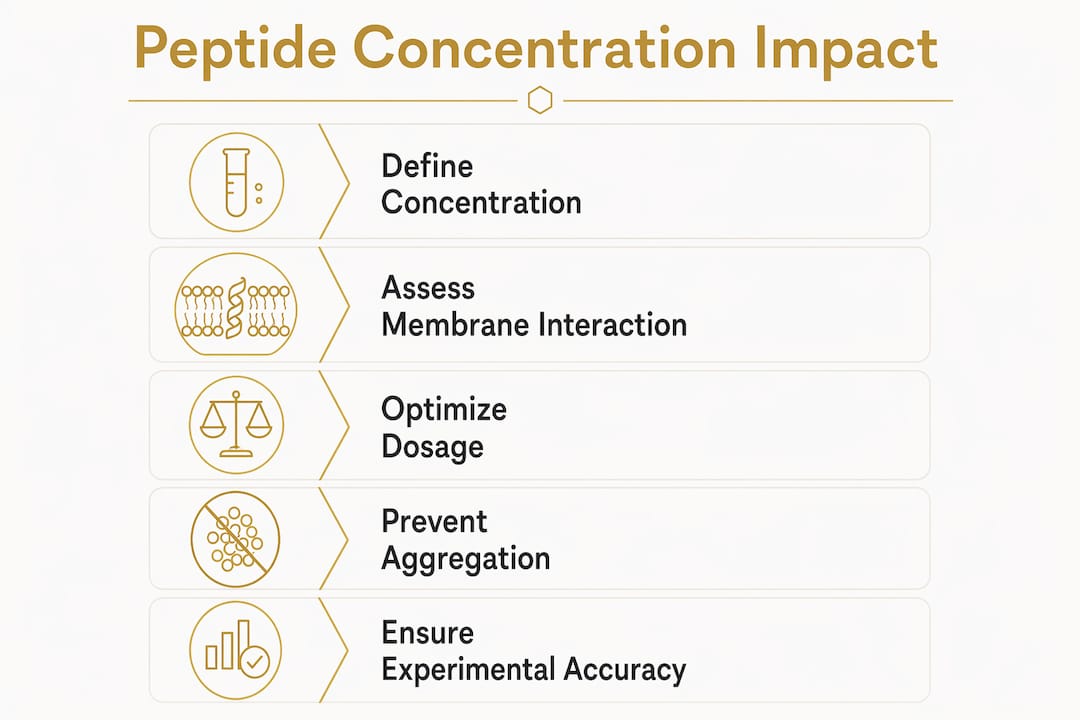
Peptide concentration is defined as the amount of peptide present per unit volume of solution, and it is the single most consequential variable in experimental design. Researchers who mismanage concentration introduce errors that no downstream analysis can correct. Whether you are running membrane interaction assays, cell viability studies, or binding kinetics experiments, the effects of peptide concentration on your results are direct, measurable, and often nonlinear. Understanding why peptide concentration matters in experiments means understanding the difference between analytical presence and functional availability, a distinction that separates reproducible data from noise.
Why does peptide concentration matter in experiments?
Peptide concentration determines whether a peptide behaves as a monomer, an aggregate, or a membrane-disrupting cluster. Each state produces different biological outputs. A researcher who treats these states as equivalent will generate data that cannot be reproduced across batches, labs, or assay formats.
The core problem is that concentration does not scale linearly with function. Peptide activity follows a curve of diminishing returns, where higher concentrations cause self-association and surface adsorption, reducing functional performance despite increased total peptide presence. That means doubling your peptide input does not double your signal. It often reduces it.

Surface adsorption compounds this problem. Peptides adsorb persistently on surfaces such as pipette tips and microchannels at higher concentrations, creating a gap between the concentration you measure analytically and the concentration that actually reaches your target. This discrepancy is invisible unless you account for it in your experimental design.
Over-concentration also increases costs and variability without delivering functional benefit. Higher doses add expense and often produce inconsistent results due to peptide crowding and instability. For researchers running high-throughput assays, this is not a minor inefficiency. It is a systematic source of error.
How does peptide concentration affect membrane interactions?
Peptide-lipid bilayer interactions are among the most concentration-sensitive phenomena in biochemistry. The behavior of a peptide at a membrane surface changes fundamentally depending on how many peptide molecules are present relative to lipid molecules.
Molecular dynamics simulations show that beyond a critical peptide-to-lipid ratio, peptides insert into membranes and form transmembrane clusters, altering membrane properties in a concentration-dependent manner. This threshold effect means that experiments conducted below the critical ratio will show surface adsorption behavior, while experiments above it will show insertion and pore formation. Running both conditions without recognizing the threshold produces data that appears contradictory.
Membrane composition adds another layer of complexity. Cholesterol content and peptide number both affect membrane properties and peptide embedding depth. A peptide tested in a cholesterol-rich membrane at one concentration will behave differently in a cholesterol-poor membrane at the same concentration. Researchers who do not control for both variables simultaneously cannot isolate the effect of concentration alone.
The practical implication is clear. Experiments with varying peptide levels must be designed with membrane composition held constant, or the concentration variable becomes confounded. This is a common source of irreproducible results in antimicrobial peptide research and neurotherapeutic peptide studies alike.
Pro Tip: When designing membrane interaction assays, run a concentration series from sub-threshold to supra-threshold levels and map the transition point. That inflection tells you more about peptide mechanism than any single concentration data point.
Dosage vs. concentration: what is the real difference?
Researchers frequently conflate dosage and concentration, and the confusion costs them data quality. Peptide dosage refers to total amount used, while concentration refers to amount per unit volume. Misunderstanding this distinction leads to inconsistent or misleading results, particularly in assays where volume varies across wells or conditions.
Consider a 96-well plate assay where one researcher adds 10 µL of a 1 mg/mL stock to each well and another adds 20 µL of a 0.5 mg/mL stock. The total peptide dosage is identical. The concentration in the well differs if total well volumes are not matched. Both researchers believe they are running the same experiment. They are not.
Stock solution preparation is where this problem originates. Recommended stock concentration is 1–2 mg/mL to balance solubility, handling volume, and functional activity. Lower concentrations help with small volume handling. Higher concentrations risk aggregation before dilution even begins.
The table below compares common dosing strategies, their advantages, and their risks.
| Dosing strategy | Advantage | Risk |
|---|---|---|
| Low stock (below 1 mg/mL) | Reduces aggregation risk | Large volumes required; pipetting error increases |
| Standard stock (1–2 mg/mL) | Balances solubility and handling | Requires accurate dilution math |
| High stock (above 2 mg/mL) | Minimizes volume in small-format assays | Aggregation before dilution; surface adsorption |
| Serial dilution from stock | Enables concentration-response curves | Cumulative pipetting error across dilutions |
The key takeaway from this comparison is that no single strategy is universally correct. The right approach depends on your assay format, your peptide’s solubility profile, and the concentration range you need to test.
What does the research say about concentration effects on experimental outcomes?
The scientific literature on peptide concentration effects is consistent on one point: the relationship between concentration and function is nonlinear, and the inflection points matter more than the absolute values.
Molecular dynamics studies on peptide-lipid bilayer systems confirm that adsorption and insertion increase beyond a threshold concentration. Below the threshold, peptides sit at the membrane surface. Above it, they insert and cluster. The transition between these states is sharp, not gradual. Experiments that sample only one side of this transition will miss the mechanism entirely.
“The presence of multiple peptides affects diffusivity and membrane packing, with effects varying by membrane composition and peptide concentration.” This finding from molecular dynamics research on neurotherapeutic peptides confirms that concentration is not an isolated variable. It interacts with every other parameter in the system.
The table below summarizes key findings from studies examining how peptide concentration influences experimental results.
| Study focus | Key finding | Implication for researchers |
|---|---|---|
| Peptide-lipid bilayer dynamics | Insertion and clustering occur above a critical peptide-to-lipid ratio | Run concentration series to identify threshold |
| Membrane composition effects | Cholesterol content modifies peptide embedding depth at fixed concentration | Control membrane composition across all conditions |
| Surface adsorption in assays | Analytical concentration exceeds functional concentration at high doses | Measure functional output, not just input concentration |
| Cosmetic peptide dose-response | Efficacy plateaus or declines above optimal concentration | Avoid assuming more peptide equals better performance |
The pattern across these studies is consistent. Concentration-dependent behavior is real, it is nonlinear, and it is system-specific. Researchers who treat concentration as a simple dial to turn up or down will misinterpret their data.
Best practices for controlling peptide concentration in lab experiments
Controlling peptide concentration starts before the experiment runs. The preparation stage determines whether your nominal concentration matches your functional concentration.
- Prepare stock solutions at 1–2 mg/mL. This range minimizes aggregation while keeping volumes manageable for dilution into working concentrations.
- Verify purity before use. HPLC purity testing confirms batch consistency and links analytical purity to confident concentration usage. A peptide that is 85% pure at a nominal 1 mg/mL is functionally closer to 0.85 mg/mL of active compound.
- Run a concentration-response curve for every new peptide. Never assume that the concentration used in a published protocol will transfer directly to your system. Membrane composition, buffer conditions, and assay format all shift the optimal range.
- Account for surface adsorption losses. Use low-binding tubes and pipette tips when working with peptides prone to surface adhesion. This is especially relevant at concentrations above 1 mg/mL.
- Document functional availability, not just input concentration. Measure your biological output across the concentration range and identify where the curve flattens or reverses. That point defines your working window.
Pro Tip: If your concentration-response curve shows a plateau or decline at higher doses, do not increase concentration further. Instead, examine whether aggregation, surface adsorption, or membrane saturation is the limiting factor. Solving the mechanism is faster than escalating dose.
When initial concentrations do not yield expected results, the first step is to check purity and solubility before adjusting dose. A peptide that has partially aggregated in storage will behave as if the concentration is lower than measured. Resolubilization or fresh preparation often restores expected activity without any change to the nominal concentration.
Key takeaways
Peptide concentration significance lies not in the total amount used, but in how that amount translates into functional, bioavailable peptide within your specific experimental system.
| Point | Details |
|---|---|
| Concentration is nonlinear | Increasing peptide concentration does not proportionally increase activity; function peaks and then declines. |
| Dosage differs from concentration | Total peptide amount and amount per volume are distinct; confusing them produces inconsistent assay results. |
| Surface adsorption reduces availability | Peptides lost to pipette tips and vessel walls lower functional concentration below the analytical measure. |
| Membrane threshold effects are real | Peptides shift from surface adsorption to transmembrane insertion above a critical peptide-to-lipid ratio. |
| HPLC purity validates dosing accuracy | Batch purity directly affects functional concentration; always verify before running experiments. |
The variable researchers underestimate most
Researchers consistently underestimate how much the gap between analytical concentration and functional concentration costs them. I have seen labs run months of experiments at a concentration that looked correct on paper but was delivering a fraction of the expected active peptide to the target. The culprit was surface adsorption in standard tubes combined with a peptide that had partially aggregated during storage.
The instinct when results are inconsistent is to increase concentration. That instinct is wrong more often than it is right. Increasing concentration in a system already experiencing surface saturation or aggregation amplifies the problem. You get more peptide stuck to surfaces and more peptide in non-functional aggregates, not more peptide reaching the target.
What actually improves results is understanding the system. Map your concentration-response curve. Identify the threshold where behavior changes. Use GHK-Cu research as a reference point for how concentration-dependent tissue interactions play out in practice. Then design your experiment around the functional window, not the maximum tolerated dose.
The researchers who generate the most reproducible data are not the ones using the most peptide. They are the ones who understand exactly what their peptide is doing at each concentration point in their specific system.
— Mithun
How Vanguardresearchlabs supports accurate peptide concentration work
Accurate concentration management starts with knowing exactly what is in your vial. Vanguardresearchlabs supplies research-grade peptides with purity exceeding 99%, verified by third-party HPLC testing and backed by certificates of analysis for every batch.

When your starting material is consistent, your concentration calculations are reliable. Vanguardresearchlabs includes batch-specific purity data so researchers can calculate true functional concentration rather than relying on nominal values. Same-day shipping for orders placed before 2 PM CST means your experiments stay on schedule. For labs where batch consistency and verified peptide purity are non-negotiable, Vanguardresearchlabs provides the foundation that accurate concentration work requires.
FAQ
Why does peptide concentration matter in experiments?
Peptide concentration determines whether a peptide functions as a monomer, aggregate, or membrane-inserting cluster. Each state produces different biological outputs, making concentration the primary driver of experimental accuracy and reproducibility.
What is the difference between peptide dosage and concentration?
Dosage is the total amount of peptide used, while concentration is the amount per unit volume. Confusing the two leads to inconsistent assay conditions and misleading results, particularly in multi-well plate formats.
What is the recommended stock solution concentration for peptides?
The recommended stock concentration is 1–2 mg/mL. This range balances solubility and handling volume while minimizing the aggregation risk that occurs at higher concentrations.
How does surface adsorption affect peptide concentration in assays?
Peptides adsorb persistently onto pipette tips, tubes, and microchannels at higher concentrations. This reduces the functional concentration reaching the target below the analytically measured value, creating a gap between what you add and what acts.
How can researchers verify peptide concentration accuracy?
HPLC purity testing confirms batch consistency and links analytical purity to reliable dosing. A peptide with lower-than-expected purity delivers less active compound than the nominal concentration suggests, making purity verification a prerequisite for accurate concentration control.
Recommended
- Buy Premium Vanguard Peptides Online | Shop Vanguard Research – Vanguard Research Labs: Premium Laboratory Grade Research Peptides. Accelerate your molecular analysis with highest-purity chemical structures. When laboratories opt to buy premium assets, Vanguard Research Labs serves as the definitive benchmark for absolute batch consistency. Our lyophilized structures are engineered exclusively for laboratory testing, cell assays, and in-vitro evaluations.
- Why HPLC Purity Testing Matters for Peptide Research – Buy Premium Vanguard Peptides Online | Shop Vanguard Research
- Research – Buy Premium Vanguard Peptides Online | Shop Vanguard Research
- GHK-Cu Research: What Studies Say About Copper Peptides and Tissue Remodeling – Buy Premium Vanguard Peptides Online | Shop Vanguard Research